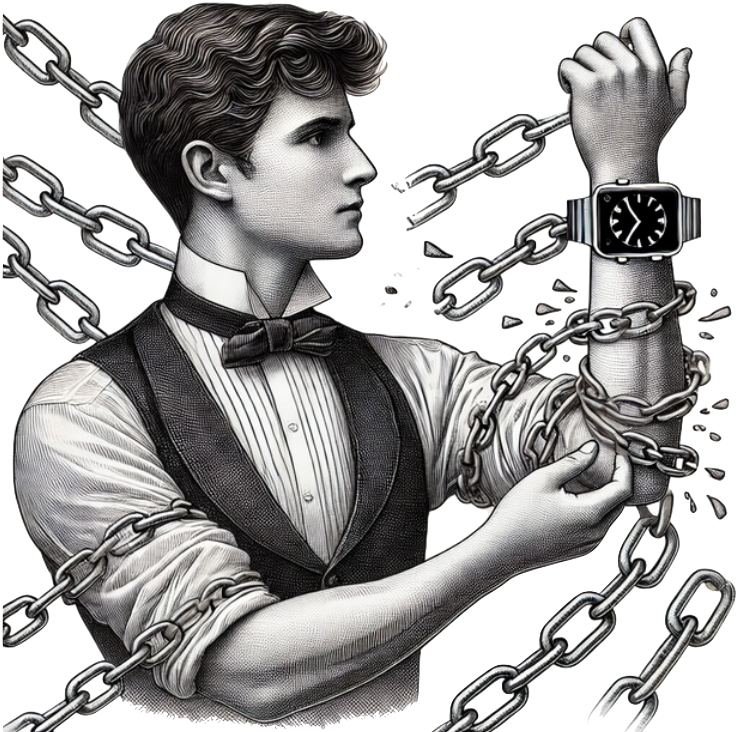
Welcome to HOUDINI-BD
HOUDINI-BD (High-resolution Ongoing Unsupervised Data-efficient Identification of Novelties within Individuals – Bipolar Disorder) is a research study sponsored by Imperial College London and funded by NIHR Imperial Biomedical Research Centre and Imperial College London Faculty of Medicine. The study protocol was approved by the relevant ethical committee.


The Study
Bipolar disorder is a common mental health condition characterized by significant shifts in mood, energy, and sleep patterns during recurring episodes, interspersed with periods of relative stability. One of the main challenges in care is that changes in mood, energy, and sleep often begin between clinic visits, while patients struggle to recognise and report their symptoms. This makes new episodes difficult to detect and address early, leading to worse outcomes.
The "Blood Sugar" Analogy
At present, there is no simple, objective test for monitoring bipolar disorder—nothing comparable to the finger-prick blood sugar test used in diabetes care. As a result, early warning signs can be missed, thus limiting opportunities for timely support or intervention.
A Modern Solution
Smart wristbands (such as smartwatches) offer a potential way to bridge this gap. By tracking sleep and activity levels continuously and with minimal effort, they provide an ongoing view of everyday patterns. Subtle changes in these rhythms may signal that a person’s mental state is beginning to shift.
The HOUDINI-BD Mission
HOUDINI-BD will be exploring whether this type of technology can be a practical and reliable way to support the monitoring of bipolar disorder in daily life. The study is observational and does not provide diagnosis or treatment. We focus on two main areas:
Working closely with Lived Experience Experts (people with bipolar disorder, their family members, and healthcare staff) to understand whether the technology is comfortable, acceptable, and useful in real-world settings.
Developing and testing analytical methods that aim to identify patterns in activity and sleep data indicative of an upcoming bipolar episode.
Take Part
Who can take part?
Are you an adult living with bipolar disorder who has experienced mood episode(s) in the last two years?
If so, you may be eligible to take part in our study. Please take our 5-minute questionnaire below to help us find out if you are eligible. By wearing a smart wristband in your day-to-day life, you would help us develop solutions to spot early signs of new bipolar episodes and improve future care. As a thank you for your contribution, you will receive £30.00 after each study appointment.
It is up to you to decide whether or not to take part. If you decide to take part, you are still free to withdraw at any time and without giving a reason. A decision to withdraw at any time, or a decision not to take part, will not affect the standard of care you are receiving, now or in the future.
Below is an overview of the study procedures and how we handle your data. Please refer to the downloadable Participant Information Sheet for further details.
Please read carefully before deciding to take part. If you have any questions, feel free to contact the research team.
What can I expect if I take part?
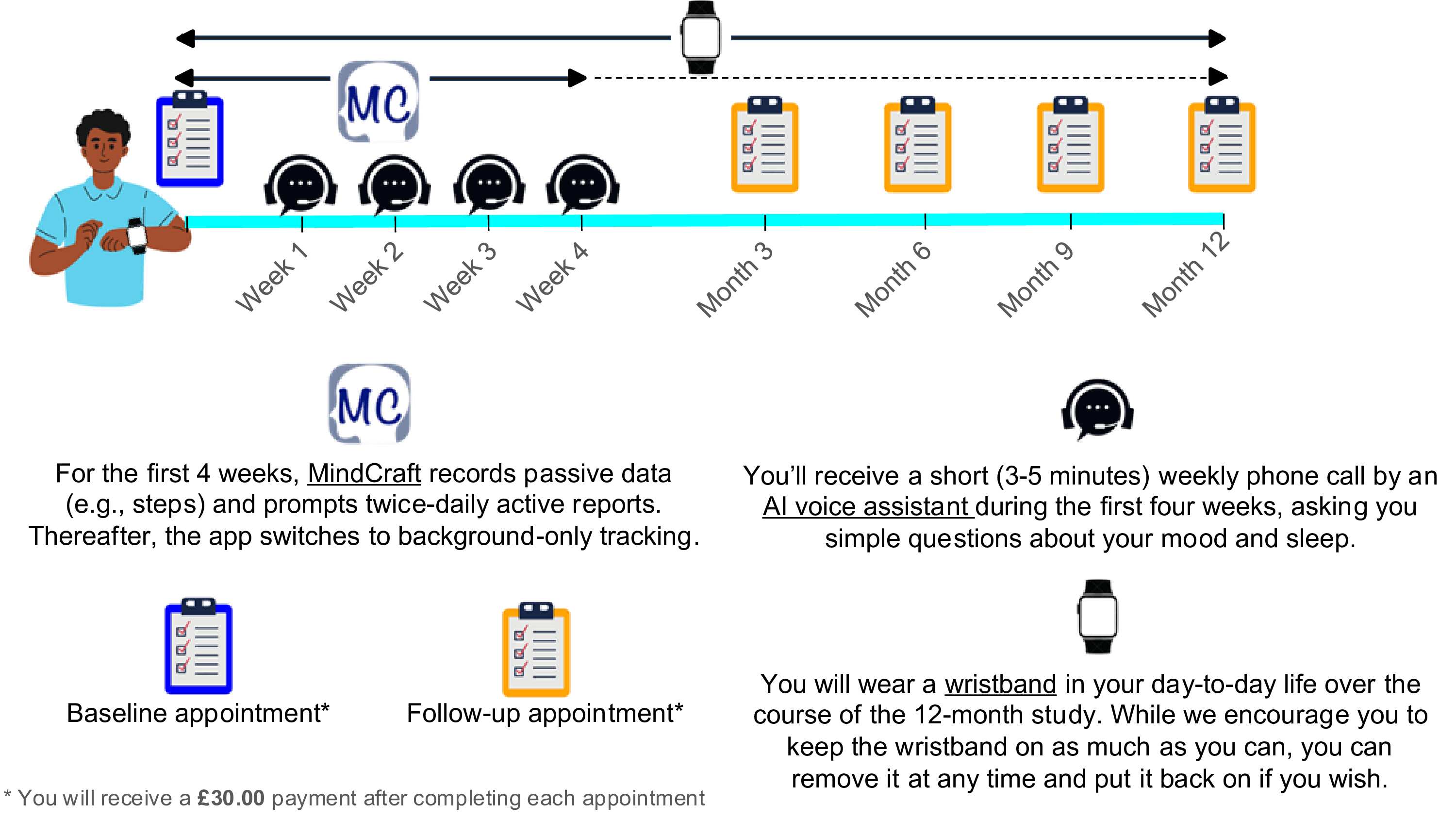
If you are eligible after screening and choose to participate, we will arrange a baseline appointment with you at one of the West London NHS Trust (WLT) Community Adult & Recovery Mental Health Services. This visit will take approximately 70–80 minutes; you will be able to take breaks at any point to ensure you stay comfortable. During the baseline appointment, you will have a chance to ask any questions you may have about the study. If you decide to take part, we will ask you to sign a consent form and we will collect some information about your mental health history and demographics (e.g. age, sex, occupation). You will also complete a brief speech task (5 minutes) where you will be asked to speak about neutral topics. This will be audio-recorded using a secure system. During the baseline appointment, will then provide you with a smart wristband (further details below) to wear on your nondominant wrist over the next 12 months in your daily life. We will periodically send you (over email or text message) reminders to wear and recharge the wristband. Following the baseline appointment, you will receive your first £30.00 payment.
During the baseline appointment, we will provide you with a unique login and a link to download the MindCraft app from the App Store or Play Store (further details below). This app runs in the background to track activity, such as steps, ambient light, and background noise levels. While more data helps us better understand bipolar disorder, you remain in control and can turn these tracking options on or off at any time.
For the first four weeks of the study, the MindCraft app will also prompt you twice daily to answer a few short questions about your mood and sleep. During this same 4-week period, you will receive brief (3–5 minute) weekly phone calls from an AI Voice Assistant (further details below). This assistant will ask about your wellbeing and health to help us collect and analyze speech samples securely.
After these first four weeks, the daily surveys on MindCraft and the AI Voice Assistannt phone calls will stop. For the remainder of the 12-month study, you will simply continue wearing the wristband and allow the MindCraft app to collect background data based on the settings you have chosen (which you can update at any point). You can contact the research team at any point if you have questions or need help with any of the technology.
To see how you are getting on, we will meet for four short follow-up appointments (30–40 minutes) every three months, in the same location as the baseline appointment, over the course of the 12-month study. You will receive £30.00 after each appointment (totalling £150.00 over the course of the entire study, including the baseline appointment). If you withdraw from the study before completing it, you will retain any payments given up to that point. During these follow-up appointments, we will download data collected in-between appointments with the wristband. Lastly, you will also complete a brief speech task (5 minutes) similar to the one completed at the baseline appointment. We will use a questionnaire to determine whether any mood episode took place in between assessments or is ongoing and we will ask you about any changes in your medications. During the first follow-up appointment, you will take a survey on your experience with the technology during the first three months of the study. Speech from the speech task and survey on technology experience will be securely recorded for analysis. No other speech data will be recorded during the follow-up appointments.
Below you can find an illustration of the study procedures discussed above (Figure 1) along with more details on the wristband you will be wearing, the MindCraft app, and the AI Voice Assistant.
Wristband
You will use the Axivity AX6 wristband. This is a small, water-resistant wristband designed to measure everyday activity and sleep. It has been widely used across various research studies.
The wristband uses built-in motion, light, and temperature sensors to track patterns of activity and rest. From this information, we can estimate things like activity levels and sleep–wake patterns, and also check whether the device was being worn.
The AX6 records data securely on the device itself and does not send information in real time. You do not need to install any apps on your smartphone to use the AX6 wristband. We will download the data during your follow-up visits.
With the study settings, a full charge takes approximately two hours and the battery lasts about three months. So, you will usually only need to recharge the device once between quarterly follow-up visits. When we contact you to remind you about an upcoming visit, we will also remind you to recharge the wristband.
To help you remember to wear the device, we will send reminders by text message. While we encourage you to keep the wristband on as much as you can, you can remove it at any time and put it back on if you wish.
Please visit the Wristband Information Page for details on how to wear the wristband and how to recharge it.

MindCraft App
MindCraft was developed by the Brain & Behaviour Lab, Department of Bioengineering, Imperial College London, in collaboration with Lived Experience Experts.
It is a user-friendly app designed to passively collect data from smartphone sensors (e.g. step count, background noise, or location). You will set your data-sharing preferences when you first set up the app, and you can change them at any time in the app’s settings. For example, if you feel uncomfortable sharing a particular type of data, such as GPS location, you can choose to exclude it, and this will not prevent you from continuing in the study.
MindCraft will also prompt you twice daily to respond to brief questions about your mental health (e.g. sleep and mood).
After the first four weeks, twice daily surveys on MindCraft will stop whereas background data collection will continue throughout the study.
Please visit the MindCraft Information Page for details on how to install the app, how to change your background data sharing preferences, and what the daily surveys look like.
AI Voice Assistant
During the first four weeks of the study, you will receive a weekly automated phone call lasting approximately 3–5 minutes. A secure computer system will ask short, structured questions about your mood, wellbeing, symptoms, and daily activities, and your responses will be audio-recorded for research purposes only.
This system is designed to stay focused on these specific topics; it does not provide medical advice or make clinical decisions. AI Voice Assistant phone calls during the first four weeks of the study and speech tasks during in-person appointments are powered by Psyrin, our industry partner. Psyrin specializes in conversational AI technology built to facilitate structured clinical assessments and speech data collection with HIPAA-compliant, enterprise-grade security.
The underlying language technology is powered by Google’s conversational artificial intelligence (Gemini Flash 2.5). However, strict agreements are in place across all platforms to ensure that Google and third parties cannot access or use your conversation data for any secondary purpose, including the training of AI systems.

How will you use and protect my data?
To carry out this research, we will need to use information collected from you while you take part in the study.
What information we will collect
This includes:
- Your name and contact details
- Health and background information, such as the number of past bipolar episodes, current medications, and your answers to questionnaires
- Information collected through the MindCraft app
- Data from the Axivity AX6 wristband
- Audio recordings, including:
- recordings made during speech tasks at the baseline and follow-up appointments,
- recordings from the weekly 5-minute phone calls during the first four weeks of the study,
- recordings of your responses to questions around technology experience at the baseline and follow-up appointments
Who will use this information
- Members of the study team and authorised staff at Imperial College London will use this information to carry out the research.
- Some staff may also check records to make sure the study is being run properly and that contact details are correct.
- People who do not need to know who you are will not see your name or contact details.
- Wherever possible, your data will be labelled with a code number instead of your name.
- Imperial College London is the sponsor of this research and is responsible for keeping your information safe.
How we keep your information safe
We use a range of secure systems and procedures:
- Screening questionnaires are collected using Qualtrics, a system that complies with UK GDPR rules. Data are stored on secure Qualtrics servers and then transferred to Imperial College servers. Once transferred, the data are deleted from Qualtrics. If someone does not meet the study criteria or decides not to take part, their data will be destroyed.
- Personal identifiable information (such as consent forms and contact details) is stored in locked cabinets at the study sites.
- Phone calls between you and the research team (for example, to ask questions or arrange appointments) are not recorded.
- Clinical and background information is stored securely using REDCap, a GDPR-compliant research database.
- Speech recordings are handled securely:
- In-person recordings are stored using encrypted, HIPAA-compliant software.
- Automated phone calls use a secure, encrypted system.
- These systems are designed so that audio data cannot be used for other purposes, including training artificial intelligence systems.
- AX6 wristband data are downloaded during follow-up visits onto an Imperial College-owned laptop and then uploaded to a secure Imperial College server.
- MindCraft app data (such as app use and behaviour data) are sent directly to a secure server located within Imperial College London.
Sharing anonymised data (optional)
You can choose whether or not your anonymised data may be shared publicly by selecting the relevant option on the consent form. If you agree:
- Your data will be shared without any information that identifies you.
- Sharing anonymised data helps make research more transparent and allows other researchers to build on the findings.
To reduce the risk that someone could identify you:
- Time stamps from the AX6 wristband will be shifted slightly, and data will be resampled.
- Information on ethnicity and employment will only be shared in grouped form across all participants.
- Age will be shared in 5-year bands (for example, 21–25 rather than a specific age).
- Location data from your smartphone, if collected through the MindCraft app, will not be shared.
- Voice recordings will not be shared; only anonymised text transcripts may be shared.
🚀 Ready to start? Please complete our 5-minute screening questionnaire to help us find out if you are eligible:
Complete the Screening Questionnaire →Cohort & Progress
We aim to recruit around 40 participants. As the HOUDINI-BD study progresses, we will herewith share updates on the study population (e.g. total number of participants joined, hours of wristband data recorded, cohort age and sex distribution, etc...) and research findings.
Participants' Personalized Summary
To keep participants informed about their contribution, we will email them with a personalized summary of their sleep-wake patterns and energy levels as recorded by their wristband. This summary is intended to help particiapants better understand their sleep-wake and energy levels patterns; it is provided for information only and does not constitute medical advice.
Research Team


Contact Us
Please reach out to us using the contact details below. Alternatively, if you prefer, please leave your contact email and your message in the boxes below and click on 'Send email'. An email will be sent to the research team at the email address below through the GDPR-compliant (General Data Protection Regulation) Formspree service.